A gas strut on a horse float ramp is a sealed, pressurised cylinder that takes most of the weight out of lifting the ramp and slows its descent so it does not crash down. To replace one, you need four numbers from the old strut: the force in Newtons (N), the extended length, the stroke and the end fitting type. Always replace struts in pairs, and always support the ramp independently before you touch them.
This guide covers what the struts do, how to read and measure an existing strut, how force and mounting position work together, a safe fitting sequence, and the warning signs that mean it is time to act.
What gas struts actually do on a float ramp
A ramp is heavy, hinged at one edge and awkward to handle. A gas strut stores energy in compressed gas and releases it as you lift, so the ramp feels lighter. On the way down, oil inside the cylinder damps the movement. The result is a ramp that lowers gently rather than dropping.
That controlled lowering matters for the horse. One German spring manufacturer notes that gas springs in horse trailers help panels lower slowly so horses can be led in and out without being frightened, and that they make closing easier and more secure. A UK manufacturer adds that gas struts stop heavy ramps slamming down, which could damage equipment or injure someone. It also explains that a failing strut tends to lose pressure gradually rather than break suddenly, so the oil keeps damping the movement for a while.
Two points to keep in mind:
- Struts assist, they do not carry the whole job. Ramp cables or chains, hinges, latches and the frame still do their own work. A strut is never a substitute for correctly rated support hardware.
- Never rely on struts alone while you work. Do not stand or reach under a raised ramp held up only by struts. Support it separately whenever you load, service or repair.
Read the old strut before you buy anything
If your float already has struts, the old ones are your best reference. Most carry a printed label or stamp on the body. Before you remove anything, photograph the struts in place, showing both ends and the brackets. Then record:
- Force in Newtons. Usually printed as a number followed by N, for example 600N.
- Extended length. Measured centre to centre of the two end fittings with the strut fully extended, not tip to tip.
- Stroke. The distance the rod travels between fully compressed and fully extended.
- Rod and body diameter. Often written as two numbers, such as 8/19 for an 8 mm rod and a 19 mm tube.
- End fittings. Most horse float struts use ball sockets that snap onto ball studs. Others use eyelets or clevis ends.
A small note on the numbers: if the label has worn off and the strut has lost its pressure, identifying a replacement from the strut alone can be hard. In that case you work from the geometry of the ramp itself, as covered below.
Measuring a strut that is still installed can be tricky because not every strut compresses by hand. The Stabilus specification guide says you may need to take the compressed measurement while the strut is still installed, and that you should replace struts in pairs and fit the new one in the same orientation as the original, with the rod and cylinder ends the same way round.
Quick reference: the measurements that matter
| Measurement | How to take it | Why it matters |
|---|---|---|
| Force (N) | Read the printed value on the body | Sets how much weight the strut supports |
| Extended length | Centre of one fitting to centre of the other, fully extended | The strut must fit the mounting points when the ramp is open |
| Stroke | Extended length minus compressed length | Determines whether the ramp can open and close fully |
| Rod / tube diameter | Calliper or ruler across the thin rod and the thick body | Helps match the correct model |
| End fitting | Check the shape and size of the socket | Must suit your ball studs or pins |
Write these down together with a sketch of where each end mounts. If you ever change the bracket position, that sketch is what lets you work out the right strut again.
Why there is no single right Newton rating
People often ask what size strut a horse float ramp needs. There is no universal answer. The right force depends on how heavy the ramp is, where its centre of gravity sits, how many struts you use, where the brackets are and how far you want the ramp to open. A 600N strut might suit one ramp and be completely wrong for another of similar weight if the mounting points or open angle differ.
Mounting position changes everything
The closer a strut mounts to the hinge, the less leverage it has, so it needs more force to do the same job. Move the mounting point further from the hinge and leverage improves, but you are then limited by available space, strut travel and the strength of the bracket. Small changes in bracket position can noticeably change how the ramp feels.
Rule-of-thumb guides published by Australian strut suppliers commonly place the moving mount a fraction of the panel length out from the hinge, and suggest a strut length of roughly half the door drop for a door that opens to 90 degrees. Treat those as starting points for a new design, not as a replacement for the original specification.
If you are replacing like for like, the most reliable approach is simple: match the original force, length, stroke and mounting layout. If a previous repair has moved the brackets, do not assume the original rating is still right.

A simple way to estimate lifting load
For a new setup or a changed ramp, a workshop method many people use is this. Support the ramp at the intended open angle. Rest a length of timber or a pole under the planned strut mounting point, with the other end on bathroom scales, and note the reading in kilograms. Multiply by about 10 to get Newtons, then divide by the number of struts and add a modest margin. A reading of 20 kg, for example, means a total of around 200N of support is needed before sharing between struts and adding a margin.
This is an estimate. If the ramp is heavy, the geometry is unusual or you are redesigning the mounting, get a competent person to confirm the figures. WorkSafe Queensland says the strut configuration, including design, orientation, load capacity and geometry, should be set by a competent person.
Too weak and too strong both cause trouble
A strut that is too weak lets the ramp drop, feel heavy or fail to stay open. A strut that is too strong can make the ramp spring up, resist closing and put extra stress on hinges and mounts. Fitting a higher rating than specified is not a safety upgrade. If a ramp misbehaves, find out why first: worn hinges, loose brackets or a bent frame are more common culprits than the strut rating.
Check stroke at both ends
With the strut fitted, it should never bottom out before the ramp is fully closed, and it should not reach full extension before the ramp reaches its intended open position. A little spare stroke at each end is what you want. Either extreme can damage the strut, the brackets or the ramp structure.
Fitting gas struts safely
Gas struts store energy. WorkSafe Queensland’s alert explains that they tend to fail in two main ways: internal damage such as forced over-extension, which can eject parts at speed, and a gradual loss of gas pressure, which lets the load creep or drop without warning. It says struts should be installed and removed by a competent person following the manufacturer’s recommendations, using appropriate protective equipment, with the work area kept clear of people not involved.
If you are not confident, have a trailer workshop or a mobile float repairer do it. If you do the job yourself, the sequence below reflects common practice.
Before you start
- Park the float on firm, level ground and chock the wheels.
- Disconnect the float from the tow vehicle if the job allows it.
- Get a helper. A ramp can be heavy and awkward for one person.
- Wear safety glasses and gloves.
Step by step
- Support the ramp independently. Use stands, a hoist or another solid mechanical support. A person holding it is not support. Remember that a failed strut may still hold some force, and the ramp can move suddenly once it is disconnected.
- Remove the old strut. Release the retaining clip on the ball socket carefully, then lift the socket off the stud. Replace struts one at a time so you can copy the original position.
- Compare old and new. Check length, stroke, force and fittings side by side before fitting.
- Check the brackets. Make sure ball studs are tight, undamaged and aligned. Fix any loose or bent bracket now.
- Orient the strut correctly. In most lifting applications, struts are fitted with the rod facing down when the ramp is closed, which helps keep the seal lubricated. Match the original arrangement unless the system is being redesigned.
- Fit the strut without forcing it. Camloc advises keeping end fixings in line to avoid side loads, using ball joint fittings where possible, fully screwing down end fittings and mounting struts in pairs. If a socket will not seat, the alignment is wrong. Do not hammer it on.
- Repeat on the other side. Replace the pair, even if one strut looks fine. If one strut has failed, the other is usually close behind in service life, and mismatched struts load the ramp unevenly.
- Test slowly. Move the ramp by hand through its full range before relying on it. Watch for binding, a ramp that twists, or one side that lifts before the other.
- Check ramp rest position. The front edge of the ramp should sit flat on the ground when down, rather than hovering above it, which can unsettle a horse stepping on. Adjust the setup if it does not.
If you have to compress a strut to get it into position, use a controlled method such as a ratchet strap, and keep fingers clear of sockets and brackets.
Signs your ramp struts or mounts need attention
Struts wear gradually, so the first signs are easy to miss if you only use the ramp occasionally. Look and listen for:
- A ramp that creeps down or will not stay open at a partial angle.
- A ramp that only holds at the very top of its travel.
- Fast, uncontrolled movement when lowering.
- Oil or gas leakage, or noise during movement.
- Pitting, chips or deep scratches on the rod. Damage to the rod surface destroys the seals.
- Dents in the cylinder body.
- Worn, cracked or loose end sockets and missing retaining clips.
- Uneven movement between left and right sides.
Most gas struts are not designed to be re-gassed or repaired. When one is worn, replacing it with a new unit is the usual answer.
If the ramp misbehaves but the struts look healthy, check the hinges, brackets, frame and mounting positions. Fix alignment problems rather than stepping up the force rating to compensate.
A simple maintenance routine
Add the ramp to your regular float check:
- Wipe the strut rod with a soft clean cloth and inspect it under good light.
- Check both end fittings and the retaining clips.
- Inspect the brackets and mounting bolts for looseness, rust or cracks.
- Operate the ramp slowly and watch for smooth, even movement.
- Check the ramp latches for rust and wear, and lubricate metal latches and hinges. A Horse Deals maintenance guide suggests inspecting the ramp, ramp springs and latches as part of regular float upkeep.
One exception to the lubrication habit: do not grease or oil the strut rod itself. The strut is sealed and maintenance-free, and the manufacturer’s guidance is to protect the rod from knocks, scratches and paint rather than treat it.
Our horse float parts guide covers what else to inspect and repair across the float, and the accessories list is useful when you are planning what to keep on hand.
Gas struts, cables and hydraulics: how the parts fit together
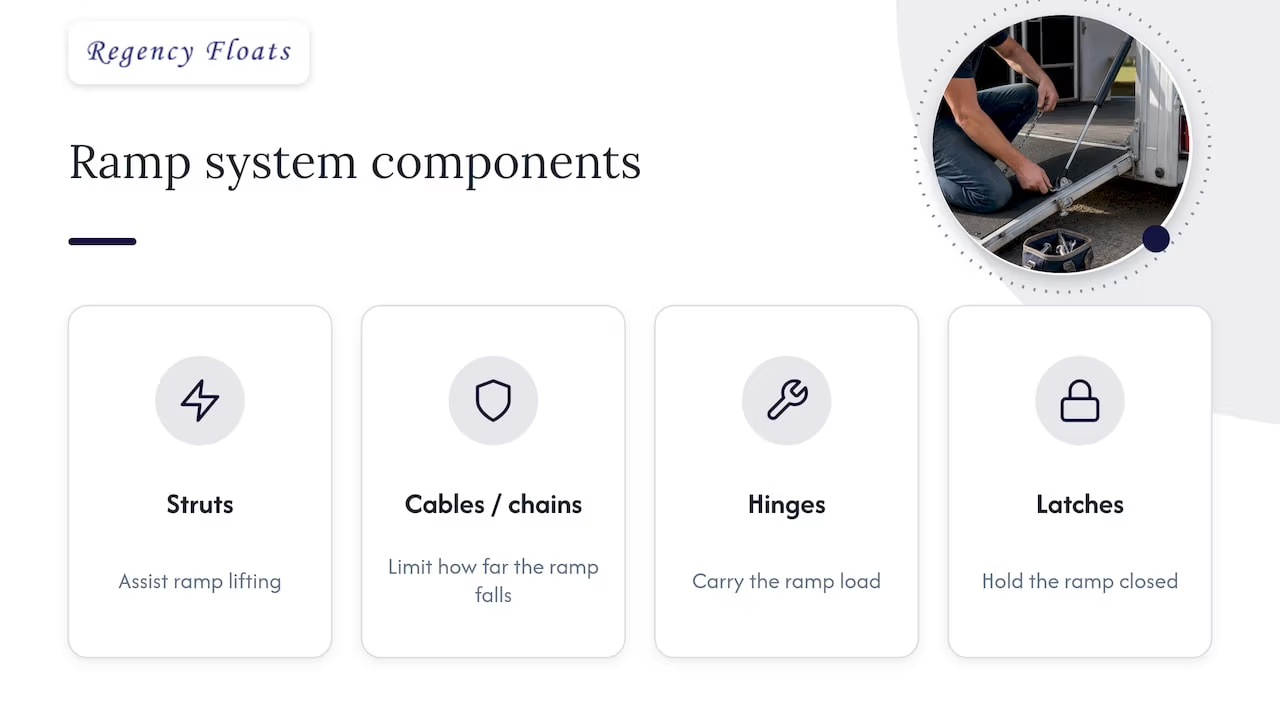
On many floats the ramp system is a combination: struts for lift assistance, cables or chains to limit how far the ramp falls, hinges to carry the load and latches to hold it closed. Each part has a job, and a problem in one often shows up as a symptom in another. A ramp that drops when partly open might point to a tired strut, but it can equally come from a worn hinge or a bracket that has shifted.
Some ramps use a different lifting approach entirely. If you want to compare, our guide to a hydraulic ramp on a horse float explains how that system works and what to check to keep it safe.
If you are still working out which float suits your horses and your towing setup, the horse float size guide is a good place to start.
Looking at a new float
If your float is old enough that the ramp, hinges and fittings all need work, it may be time to look at a new or pre-owned one. Regency Floats has more than 40 years of experience building horse floats in Australia, and our floats come with a ten-year warranty on the flooring system. We offer Standard, Deluxe, Camper, Gooseneck, Straight Load and Thoroughbred Series ranges, plus a 2 Horse range, and floors and fittings can be customised to suit how you travel.
See the full Regency Floats range to compare layouts, or talk to us about what you need for casual riding, competition or professional work.

We also supply accessories and parts for floats, so if you are unsure about a specific fitting on your ramp, ask us.
Before you order struts: a checklist
Have this information ready before you contact a parts supplier or workshop:
- Photos of both struts, both end fittings and the brackets
- Force in N, as printed on the old strut
- Extended length, centre to centre
- Stroke, or both extended and compressed lengths
- Rod and tube diameter
- End fitting type and size
- The float make, model and approximate year
- Whether the ramp, brackets or hinges have been repaired or modified
- Whether the ramp has gained weight, such as a new rubber mat or added flooring layer
That last item is easy to forget. If the ramp weighs more than it did originally, the original rating may no longer be enough.
FAQ
Can I use a stronger strut to make my ramp easier to lift?
Not as a rule. A strut that is too strong can make the ramp spring open, resist closing and stress the hinges and mounts. If the ramp feels heavy, check hinges, brackets and the mounting position first, and have the rating confirmed by a competent person.
Do I need to replace both gas struts at once?
Yes, replace them as a pair. If one has failed, the other is usually close to the same point in its service life. Mismatched struts also load the ramp unevenly and can twist it.
Where do I find the right replacement size?
Start with the label on the old strut for the force in N, then measure extended length centre to centre, stroke, rod and body diameter, and end fittings. If the label is unreadable, you will need to work from the ramp’s weight and mounting geometry, ideally with help from a trailer repairer.
Can I top up or re-gas a worn strut?
Most gas struts are not designed to be re-gassed or repaired. Replacing a worn strut with a new, pressure-tested one is the usual and safer approach.
Is it safe to stand under the ramp while I change the struts?
No. Support the ramp independently with stands or another solid mechanical support before you remove anything, because a failed strut can still hold force and the ramp can move suddenly once disconnected.