In Australia, most owners who search for a “horse float emergency door” mean the front access door on the side of the float, often called the groom door or people door. It gives you a way to reach a horse, or to get out yourself, without opening the tailgate or ramp behind a frightened animal. Some floats add storm doors, breach gates and other exits that work alongside it. This guide explains what each one does and which rules apply. It also covers how to check hinges and latches before every trip, and how to handle a horse that tries to leave the float.
What counts as an emergency door on a horse float
There is no single part sold under the name “emergency door”. The term covers a few features that work together.
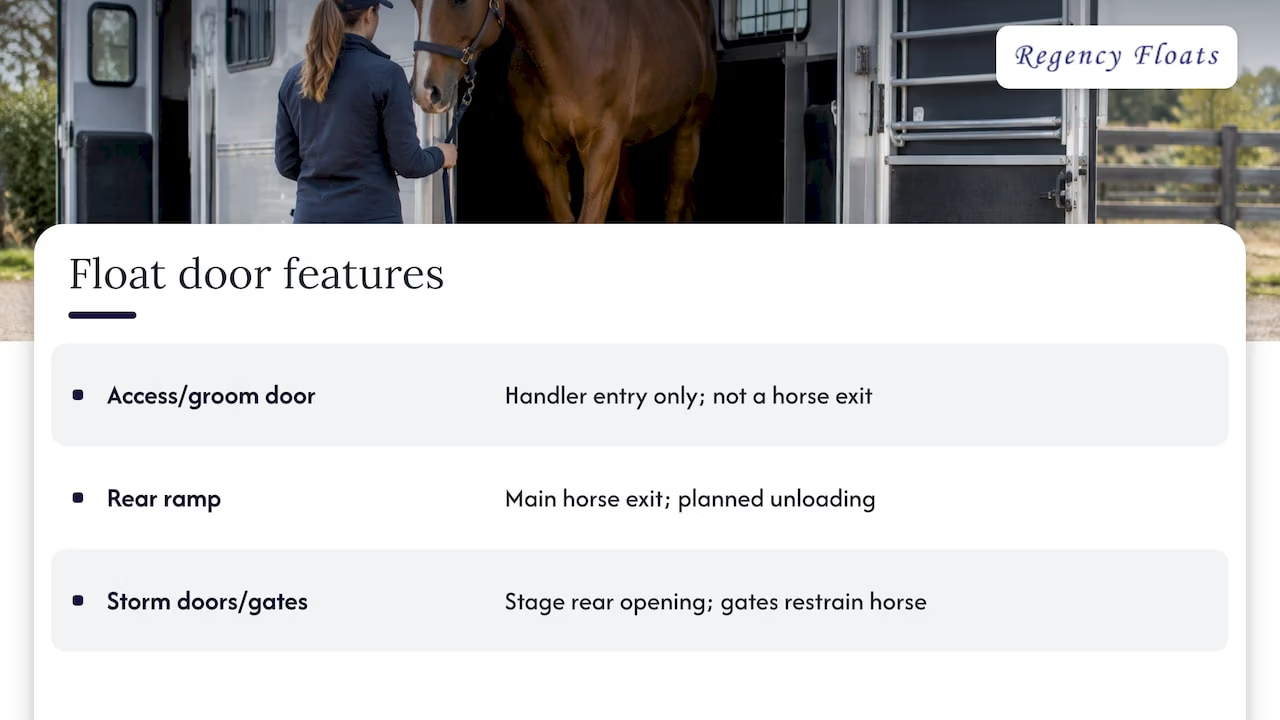
The access (groom) door. This is a small, person-sized door, usually at the front on the left-hand side of the float. It lets a handler reach the horse’s head, check a tie or calm a nervous horse without going behind the animal. It is built for people, not horses. We cover the design choices in our guide to the groom door on a horse float.
The rear tailgate or ramp. This is the main exit for the horse. In Australia, floats almost exclusively use ramps to walk a horse in and out, and a non-slip surface at a shallow angle is a key safety consideration, according to Good Horsemanship. A ramp is a loading feature, not an emergency exit, because it needs a calm, planned unload. Our article on the hydraulic ramp horse float explains how a controlled ramp supports that.
Storm doors and breach gates. Storm doors are the side-hinged or fold-back doors at the rear that let you open the back of the float in stages. Breach gates (breeching bars or chains) hold the horse in while the tailgate is open. Both change how quickly and safely you can open the back. See storm doors on horse floats for how they differ.
So the useful question is not “does my float have an emergency door?” It is “if something goes wrong, which opening do I use, and will it open when I need it?”
What an emergency door is designed to do
An access door gives a person quick entry to a horse bay in a few situations:
- A horse is tangled in a lead rope or halter and needs to be released.
- A horse is down, cast against a divider, or panicking and needs a handler near its head.
- You need to check on a horse at a roadside stop without opening the rear.
- You need to leave the float yourself if you are inside with the horse.
It is not designed to let a horse out. The doorway is far too narrow for that, and a horse that sees light through it may try to climb or push toward it. That is why you should treat the access door as a tool for the handler, keep it latched whenever the float is moving, and open it only when you have a plan. Your first move in almost any emergency is to stop safely, switch off the engine, and make the scene safe before you open anything.
The same logic applies to the rear. If a horse is struggling, the instinct is to throw open the back. Opening the tailgate on a distressed horse that is still tied, or while you stand directly behind it, can add danger. A planned order of steps, covered below, protects you and the horse.
Rules and standards that apply in Australia
There is no national rule that says every horse float must have an emergency door of a set size. What exists is a layered set of welfare and safety obligations, and an emergency door is one of the ways a float meets them.
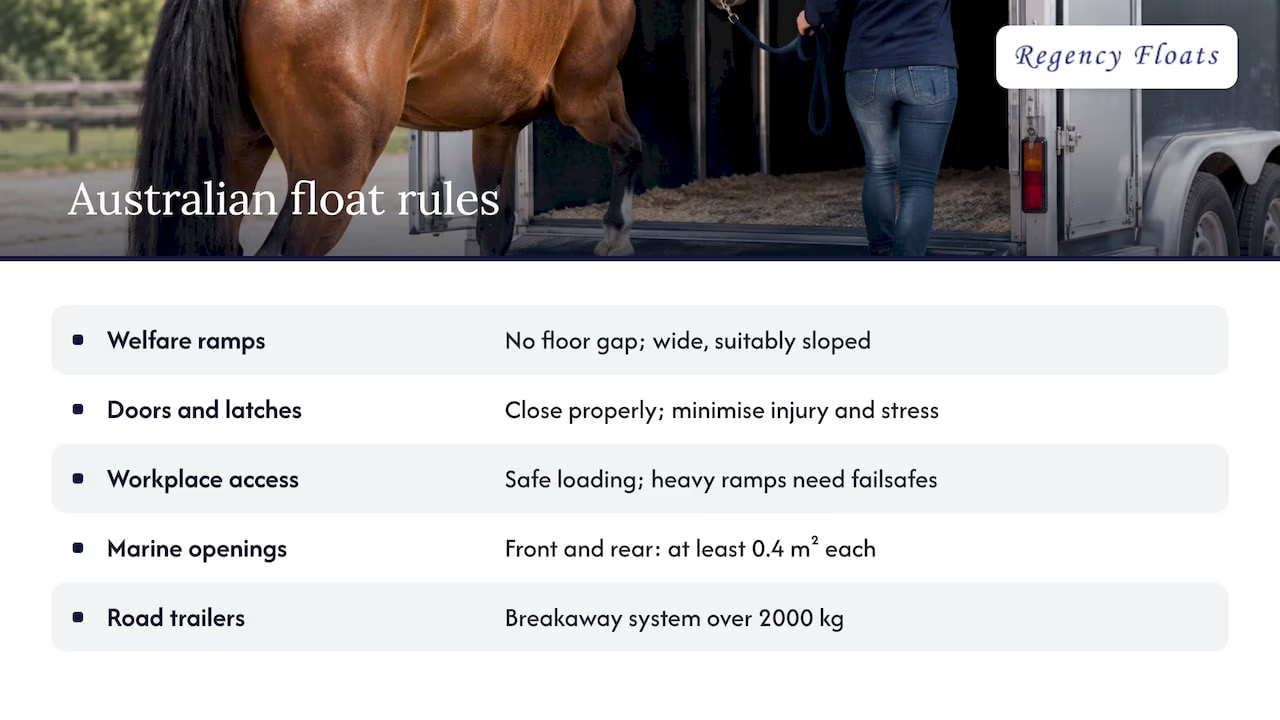
Animal welfare standards. The Land Transport of Livestock Standards were endorsed in September 2012 and cover all species previously covered by the model codes, and a review of the horse provisions is currently under way, according to the Department of Agriculture, Fisheries and Forestry. The standards and guidelines say, for example, that there should be no gap between the ramp floor and the vehicle floor through which an animal or part of an animal might fall, and that ramps need to be wide enough for easy movement and sloped appropriately for the species (Land Transport of Livestock Standards and Guidelines, Version 1.1).
Doors and latches in practice. Pony Club Australia notes that those standards require vehicles to be designed and maintained to minimise injury and stress to animals, which includes doors and latches that close properly. It adds that small faults such as worn mats, loose bolts or damaged partitions can quickly become serious safety risks.
Workplace access. If you handle horses as part of a business, WorkSafe Victoria’s guidebook states that floats and trucks should be designed to allow safe entry and exit when loading and unloading, without hazardous manual handling or trip and slip hazards, and that heavy ramps should have failsafe design features. Other states have their own requirements, so check with your state’s workplace safety regulator.
Floats carried by sea. If you ship a float on a vessel, Marine Order 43 applies. AMSA’s Marine Order 43 says a horse float must have openings to the front and rear, each not less than 0.4 of a square metre. It also says mares with small foals at foot must not travel in floats unless the foals are kept away from any doors secured open for ventilation. This rule is about marine cargo, not everyday road towing, so do not read it as a road standard.
For road use, also meet your state’s towing and trailer rules. Ranvet’s checklist notes that any trailer over 2000 kg must be fitted with a breakaway system.
What to look for when choosing a float
If you are buying, treat the doors as part of the whole safety design rather than a box to tick. These are the points we would walk through with any buyer.
Access door position and swing
The access door should open freely and wide enough for an adult to get in, and sit where you can reach the horse’s head. Check that it swings clear of the float body and cannot swing shut on you. Stand beside it with a helper and open and close it with one hand, since in a real emergency the other hand may be holding a rope.
Latches that work with gloves and in the dark
A good latch is positive: you can feel and hear it engage. It should also be easy to release under stress and should stay shut over rough roads. Try each latch several times. A latch that needs a fiddly two-step action is hard to use with a scared horse beside you.
Recessed hardware
Horses catch halters and lead ropes on anything that sticks out. Recessed handles, levers and hooks reduce the chance of a snag. It is worth running your hand around the door frame and bay to look for protrusions.
Rear door height and arrangement
The rear doors and ramp should be high enough that a horse cannot get its hindquarters over the top if it turns. Look at how the rear opens: split storm doors, a ramp with a swing door over it, or a fully enclosed rear all change what you can do at the back. Any split doors should swing around the outside of the float so they do not stick out where they can be knocked while open.
Interior that supports a calm exit
Padding, partitions and flooring all affect how a horse reacts in a scare, and how easily you can free it. Our horse float interior design guide walks through the choices, and the leg protection safety checklist covers the lower-leg risks that doors and ramps can add to.
Safety design in Regency floats
Regency Floats has built horse floats in Australia for over 40 years. Our floats are designed with advanced safety technology, European luxury design and a flooring system backed by a ten-year warranty. We offer customisable floor plans and fittings, so you can choose the access, door and interior arrangement that suits how you travel, whether that is a two horse float for weekend rides or a gooseneck for competition.
If you are comparing options, start with our horse float range or look at the 2 horse float range. Our team can talk you through door layouts for your horses and towing set-up.
If you are in South Australia, our Adelaide page lists current local stock and specials.
A pre-trip check for doors, hinges and latches
Most door failures are slow and visible long before they matter. A two-minute check before loading catches the majority. Ranvet’s pre-departure float checklist advises confirming that access doors are closed and latched before leaving, checking the tailgate or ramp for damage, upturned rubber or rust before loading, and checking again once loaded that it is latched correctly and securely. Build those into a routine like this:
- Open and close every door once. The access door, storm doors and tailgate should move freely without grinding or sticking.
- Look at hinges and pins. Check for rust, cracks, worn bushes or missing split pins. Grease moving parts as the manufacturer recommends.
- Test each latch under load. Push on the closed door. It should not flex open or rattle loose.
- Check seals and edges. Look for sharp metal, torn rubber or loose trim near the doorway where a horse or a rope could catch.
- Inspect the ramp or tailgate. Look at the surface, springs or hydraulics, and any gaps between ramp and floor.
- Confirm your quick-release tools. Keep a sharp rope cutter or safety knife where you can reach it from the access door, and make sure everyone on the trip knows where it is.
- Latch everything again after loading. Then walk around the whole float once more.
Have the float serviced regularly as well. Ranvet recommends regular servicing and checks to make sure there is no rust or structural problem that could affect the door frames and body. Our accessories list covers spare latches, locks and other items worth carrying.
Keeping doors secure while still letting air in
A closed, latched float is safer but can become hot and stuffy. Pony Club Australia’s January 2026 article states that adequate ventilation is critical for comfort in transit, and that poor airflow lets heat, humidity and dust build up, raising the risk of dehydration, heat stress and respiratory irritation. It says windows, roof vents and airflow openings should work and be adjusted for the weather and the number of horses on board (Pony Club Australia).
In practice:
- Use roof vents and windows for airflow while moving, and keep the doors latched.
- Keep the access door and tailgate closed on the road. Do not prop doors open to cool a float while you are travelling.
- If your float has a rear holding bracket for parked ventilation, use it only while stationary and with the horse secured properly. If a mare has a young foal, keep the foal away from any door that is held open.
- Adjust vents for conditions. A hot day with one horse needs a different set-up from a cool, wet day with two.
If you want a screen or mesh on windows to keep debris out, check the options in our accessories list. Keeping the float secure when parked is a separate topic; see our horse float security guide.
If a horse panics or a door will not open
The aim is to stop the situation getting worse. These steps are general handling practice, not a substitute for training; ask an experienced horse person or your vet to take you through them with your own horses.
- Pull over safely. Stop in a safe place, apply the park brake and switch off the engine. Put on hazard lights.
- Do not open the rear in a hurry. A horse that is tied and scrambling can be hurt further if the tailgate is lowered with it still tied.
- Use the access door first. Go in at the front, calm the horse with your voice and look for the cause: a tangled rope, a loose partition or a leg over a divider.
- Untie before unloading. Release the horse from its tie before any unloading begins. Norm Glenn’s float loading safety guide advises that if a horse wants to come out, you should stand aside and let it come out while holding a long lead rope, and never stand behind the tailgate when raising or lowering it.
- Cut rather than fight. If a rope or strap is trapped and the horse is at risk, cut it. This is why a rope cutter is at hand.
- Call for help early. For a trapped, down or injured horse, call your vet at once. If the situation is life-threatening for a person or animal, call 000 and tell them it involves a horse float, so the right rescue crew is sent.
A horse that panics once may do so again, so recheck the float and the way you load before the next trip. If a latch or hinge has failed, do not tow the float until it is repaired.
Frequently asked questions
Do all Australian horse floats have an emergency door?
Most floats have at least a front access door, but designs vary by model and by whether the float is a straight load, angle load or gooseneck. No single national rule sets the door’s size. The welfare standards require doors and latches to close properly and the vehicle to minimise injury risk. When you buy, ask to see how the access door opens and latches in the float you are considering.
Can a horse get out through the front access door?
It is not designed for that. The opening is sized for a person, and a horse that tries to climb toward it risks injury. Keep it latched during travel and use it as a handler’s entry point. The horse’s exit is the rear, opened in a planned way after the horse is untied.
How often should I check door latches and hinges?
Check them every time you hitch up, as part of your pre-departure routine, and look more closely at each service. Watch for rust, loose bolts, worn rubber and doors that need extra force to shut. Pony Club Australia notes that small faults can quickly become serious safety risks.
Can I leave the doors open for ventilation while driving?
No. Keep the access door and tailgate latched on the road and use windows and roof vents for airflow, adjusted for weather and the number of horses. A rear holding bracket is for ventilation while parked, with the horse secured, and a mare’s foal should be kept away from any door held open.