
There is no single national horse transport law in Australia. Each state and territory enforces its own animal welfare legislation, and most of them lean on the same national livestock transport standards. In practice, you must travel a fit horse, in a float that is strong, ventilated and non-slip, behind a vehicle that is legally and physically able to tow it, and you must respect journey-time limits. A float built around safe horse transport makes most of this easier to meet, which is why we build ours the way we do at Regency Floats. This guide explains each rule in plain terms, where the states differ and what is changing.
Who sets the rules: national standards, state laws
The national starting point is the Australian Animal Welfare Standards and Guidelines for the Land Transport of Livestock. Horses are covered by it. The standards do not become enforceable on their own: each state and territory adopts them in its own way. In Victoria, for example, the standards are adopted under the Livestock Management Act 2010. In Western Australia, minimum standard S5.1 says a person transporting a horse must follow the national land transport standards, and the vehicle must comply with road traffic laws, including towing limits, towbar and safety chain attachments, braking and speed limits.
The underlying cruelty and welfare laws differ by jurisdiction. The Commonwealth’s list of state and territory animal welfare legislation shows the main Acts:
| State or territory | Main animal welfare law |
|---|---|
| New South Wales | Prevention of Cruelty to Animals Act 1979 |
| Victoria | Prevention of Cruelty to Animals Act 1986 |
| Queensland | Animal Care and Protection Act 2001 |
| South Australia | Animal Welfare Act 1985 |
| Western Australia | Animal Welfare Act 2002 |
| Tasmania | Animal Welfare Act 1993, with the Animal Welfare (Transport of Livestock) Regulations 2025 |
| Northern Territory | Animal Protection Act 2018 |
| ACT | Animal Welfare Act 1992 |
Two practical points follow. First, a standard is a minimum, and the guidelines that sit beside it describe good practice. Second, the same trip can involve several rule sets at once: welfare law, road rules for the towing vehicle and trailer, and, for interstate or Bass Strait travel, biosecurity requirements. Treat the rules of the state you start in, any state you cross and the state you finish in as all applying.
Is your horse fit to travel?
Fitness to travel is the first legal test, and it sits with you. Tasmania’s biosecurity authority says the owner or driver is primarily responsible for assessing fitness and complying with transport welfare regulations.
Business Queensland’s land transport code lists the situations where a horse is not fit for the intended journey. Do not load a horse that:
- cannot walk bearing weight on all four legs
- is heavily pregnant, or foaled within 72 hours before loading
- is severely emaciated or visibly dehydrated
- is severely distressed or injured
- has a condition likely to increase its pain or distress during the trip
- is blind in both eyes
If you are unsure, ask your vet before the day. World Horse Welfare also recommends checking physical fitness and mental readiness, and giving forage and continuous clean water before the journey. Because horses must balance continuously while travelling, stress raises the risk of injury and illness. A horse that loads calmly and stands quietly is safer and easier to travel, and gradual, patient training before the trip is the best preparation.
What your float must provide
Agriculture Victoria sets out the clearest plain-language description of what a float must do. According to its transport and care of horses guidance:
- The float must be strong and secure enough to contain the horse.
- Internal surfaces should be smooth and free of hazards that could injure a horse.
- Floors and ramps should be non-slip.
- Each horse needs its natural standing position, headroom and air circulation.
- Where several horses travel together, use adjustable partitions at least 600 mm high and 600 mm off the floor.
The same guidance is firm on handling. Dogs and electric prods must not be used to help load a horse, and horses must not be beaten when loading or unloading. Queensland’s code goes further for electric prodders: they are prohibited on horses entirely, and dogs must be kept under control during transport.
Why flooring and design matter
Flooring is where welfare rules and daily practice meet. A non-slip, hazard-free floor that drains is part of what the standards describe, and it is the part of a float you cannot easily change later. Our floats come with a state-of-the-art flooring system backed by a ten-year warranty, and the floor plans are customisable. If you are weighing layouts, our horse float interior design guide walks through partitions, headroom and fittings, and our horse float size guide helps you match dimensions to your horse.
Towing: the rules people overlook
Many owners focus on the horse and forget that the vehicle and trailer are held to road law. Horse SA, the South Australian horse industry body, lists the main towing checks:
- The trailer’s loaded mass must not exceed the capacity of the vehicle or the towbar, whichever is lower.
- A C-class car licence has a 4.5 tonne limit.
- Trailers over 750 kg GTM (the maximum weight the trailer’s axles can carry when loaded) need brakes.
- Trailers over 2,000 kg need an electric breakaway system.
- Safety chains must be rated for the float’s ATM (aggregate trailer mass, the total loaded weight), attached with weighted D-shackles and crossed.
Western Australia’s standards echo the same themes: towing limits, towbar and chain attachments, braking and speed limits. Specific licence and registration rules vary by state, so confirm them with your road authority.
The weight people underestimate is the loaded weight. A float with two horses, tack, feed and water is far heavier than its tare weight on the compliance plate. Our guide to what a loaded horse float actually weighs shows how to work it out, and whether your tow vehicle is up to the job covers the vehicle side. For the legal side, see what makes a horse float roadworthy in Australia.
If you are buying, work out your towing capacity first and choose a float that sits comfortably inside it. A lighter float for your vehicle is a safety decision, not just a budget one.
How long can a horse travel?
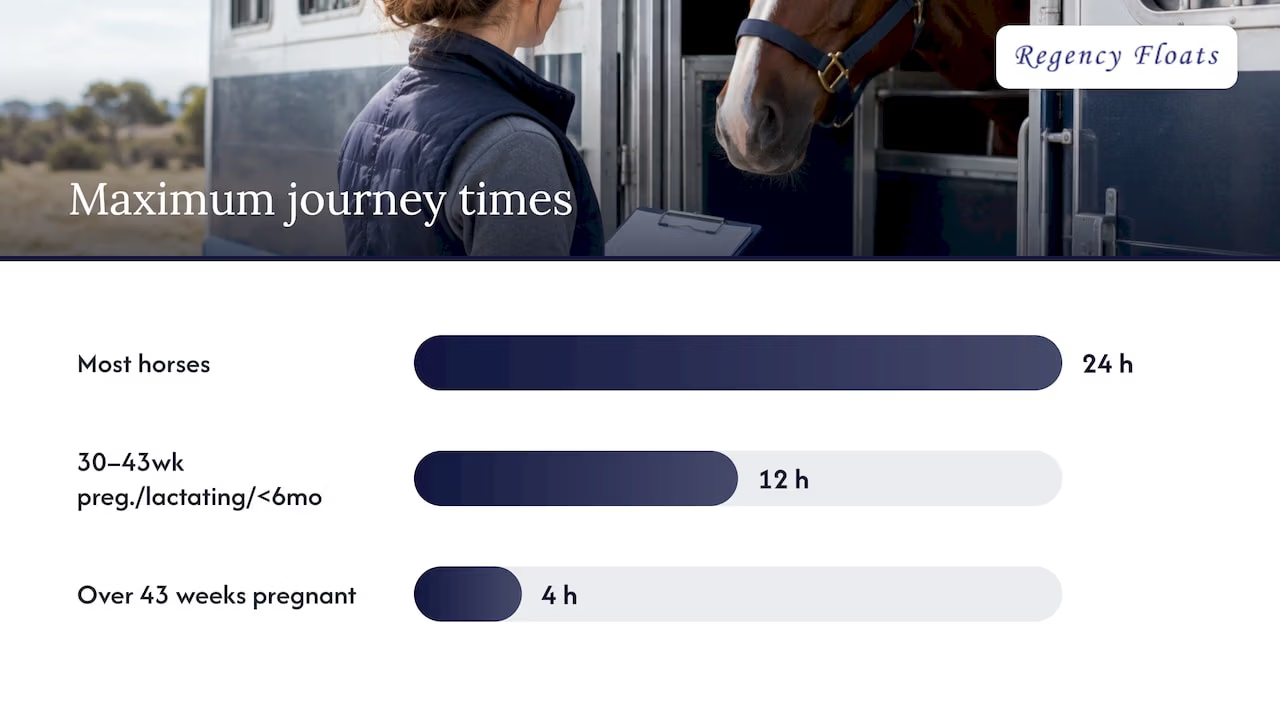
Journey limits come from the livestock transport standards, and New South Wales sets them out clearly in its Transport of Livestock Standards. Business Queensland’s code sets the same water and spell limits.
| Horse | Maximum journey time | Spell (rest) afterwards |
|---|---|---|
| Most horses | 24 hours, with a maximum of 24 hours off water | at least 12 hours |
| 30 to 43 weeks pregnant, lactating, or under 6 months | 12 hours | 12 hours |
| Over 43 weeks pregnant | 4 hours | 24 hours |
A spell is a rest period off the vehicle, with access to feed and water. The journey for most horses can stretch to 36 hours only if they are given water and feed at least every 5 hours, are sheltered, have comfortable standing space and the floor drains urine. Most owners will never approach these limits, but professional hauliers and long interstate trips do.
Agriculture Victoria’s practical advice is to check the horse 30 minutes into a long trip, then every 4 hours. Unload as soon as you arrive, offer food, water and rest, and walk a stiff horse gently until it moves freely. A float with good access to the horse, so you can check it without opening the whole rear, makes those stops quicker.
Crossing Bass Strait
Tasmania has the most specific rules for floats. Under Tasmania’s biosecurity requirements for horses:
- The owner or driver must declare in writing, before the crossing, that the horses are fit to travel.
- Horses must be single-stalled, unless a mare is travelling with a dependent foal.
- A float carrying two or fewer horses needs front and rear ventilation openings of at least 0.4 m² each.
- A vehicle carrying more than two horses needs 0.5 m² of opening per horse for the 12-hour crossing.
The penalties are real: the 2025 regulations set penalties of up to 50 penalty units for individuals where horses are not individually stalled as required. If you are heading south, check the current requirements with Biosecurity Tasmania before you book your crossing.
What is changing
The horse provisions of the national standards are under review. Queensland, on behalf of the Animal Welfare Taskforce Group, reviewed the land transport standards for their suitability for horses, and the Australian Animal Welfare website notes that a review of the horse provisions is underway.
Queensland’s consultation on the revised standards closed on 16 March 2026. The proposed changes would:
- clarify journey times and spell periods
- align record-keeping with the National Horse Traceability System
- strengthen veterinary-advice requirements
- improve vehicle design, ventilation and segregation
- prohibit electric prodders and dogs, and restrict multi-deck vehicles
Ministers are working toward national endorsement, after which the standards are meant to provide a basis for consistent rules across the country. Until your state adopts the revised version, the existing standards apply. Check your state agriculture department’s page for the current position before a long trip.
A pre-departure routine that covers the rules
- Confirm fitness. Run through the unfit-to-travel list above and call your vet if in doubt.
- Plan the journey time. Work out loading, driving and rest stops, and note any horse in a restricted category (late pregnancy, lactating, young foal).
- Check the vehicle against the float. Compare your loaded float weight with the lower of the vehicle’s and towbar’s ratings, and check licence class.
- Inspect the float. Look at the floor, ramp, partitions, latches, tyres, lights, brakes, breakaway system and safety chains.
- Provide feed and water. Give forage and clean water before loading and carry enough for the trip. Our towing and pre-departure checklist covers the legal traps.
- Load calmly. No dogs, no electric prods, no beating.
- Check on the road. Look at the horse after 30 minutes, then every 4 hours on a long trip.
- Unload and rest. Offer food, water and rest on arrival.
A well-stocked float makes this routine simpler, and our horse float accessories list sets out what to carry.
A float built for these rules
The standards describe a float that contains the horse securely, with smooth surfaces, non-slip floors, air and room to stand naturally. That is the brief we build to. Regency Floats has more than 40 years of experience manufacturing horse floats in Australia, with advanced safety technology, European luxury design and a flooring system backed by a ten-year warranty. You can choose colours, fittings and floor plans to suit your horse and the way you travel.

Whether you want a two-horse float for weekend rides or a Thoroughbred series float for competition, start with the 2 Horse Float Range or browse the full Regency float range, which includes Standard, Deluxe, Camper, Gooseneck, Straight Load and Thoroughbred Series floats.
FAQ
Do I need a licence or permit to transport my own horse?
In most cases you do not need a special permit to float your own horse within your state, but you must comply with welfare standards and road rules, including your licence class for the towing weight. Interstate and Bass Strait trips can add biosecurity and declaration requirements. Check with your state agriculture department before you go.
Can I transport a pregnant mare?
Yes, but the limits tighten. Under the NSW standards, a mare 30 to 43 weeks pregnant is limited to a 12-hour journey, and one over 43 weeks to 4 hours with a 24-hour spell. A heavily pregnant mare is not fit to travel under Queensland’s code. Talk to your vet before planning any trip.
How much does it cost to transport a horse in Australia?
Cost depends on distance, service provider and venue. As one example, a Victorian trainer’s 2026 schedule lists per-trip charges of $105 to $250 before GST for short local runs. Long-distance rates are quoted by the trip. If you travel often, owning a float is the way to control the cost per trip.
Are the rules the same in every state?
The national land transport standards are the common base, but each state and territory adopts and enforces them through its own legislation. Tasmania has additional Bass Strait requirements, and the horse provisions are under national review. Always check the rules in each state you travel through.
This article is general information, not legal or veterinary advice. For your own horse’s health, see your vet, and for the current law in your state, check your state agriculture department or road authority.

