For a standard 50 mm tow ball, the centre of the ball should sit between 350 mm and 460 mm from the ground, measured with your vehicle loaded as you will actually travel. Your float should then sit level, or very close to it, once coupled. If the nose points up or down, the ball height or hitch position is wrong, and a horse float is less forgiving of that than most trailers. Below is how to measure it, how to read what you see, how to adjust within what your tow bar allows, and what to check before you load a horse.
Why tow ball height matters more with a horse float
A horse float carries a live load that shifts, leans and reacts to every brake and corner. A float that is nose-high or nose-down changes how weight lands on the tow ball, how the axles carry the load and how the tow vehicle’s suspension behaves.
One Victorian weighing business warns that an unlevel float can affect safety, damage the vehicle and put you outside weight compliance. It lists instability, sway and extra stress on suspension and brakes among the effects. It also notes that a low front end increases tow ball mass (TBM), which eats into your vehicle’s gross vehicle mass (GVM) capacity.
A Queensland towing-weights business says much the same about hitch height on floats: if it is wrong, sway sensitivity rises, the tow vehicle carries too much ball weight, and suspension and tyres wear early. The practical point is simple. Ball height is not cosmetic. It is the first thing that decides whether the rest of your setup, weights included, can work.
The numbers to know before you measure
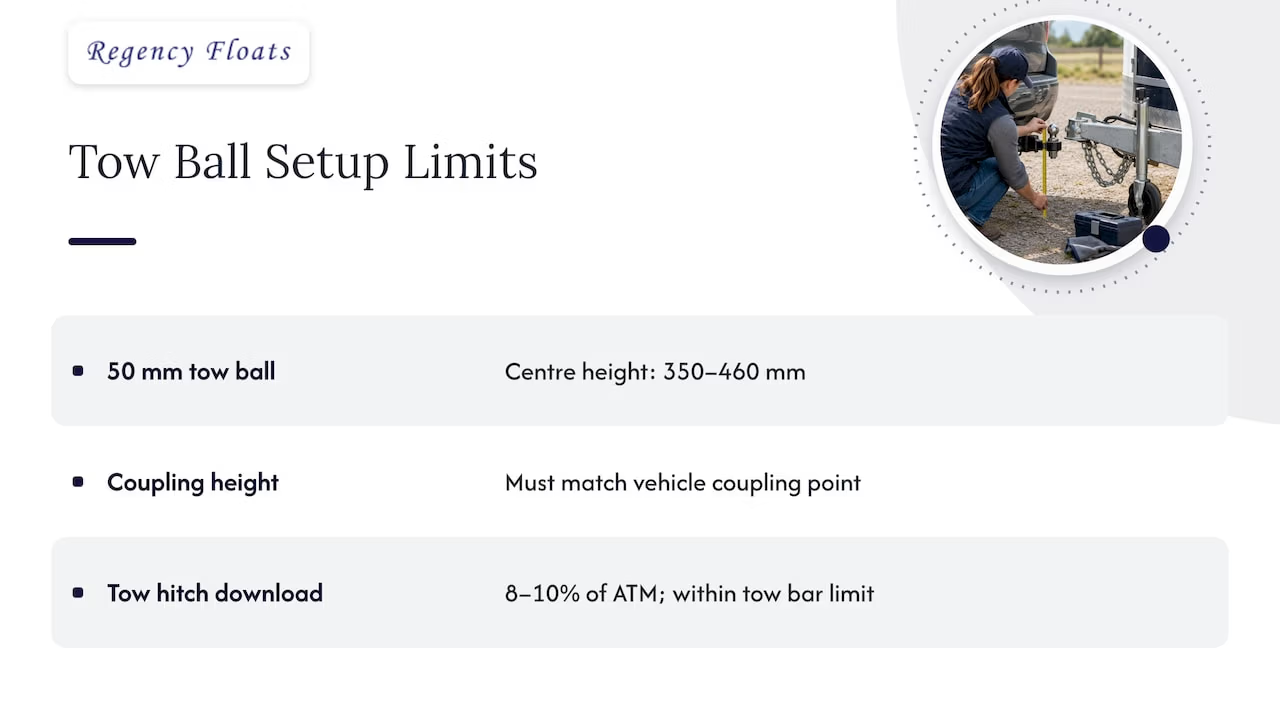
The height window. The Western Australian Department of Transport’s Safe Towing Guide says that for a 50 mm tow ball, with the vehicle in its as-used state, the tow bar must be capable of mounting at a height from 350 mm to 460 mm to the centre of the ball. The Horse Riding Industry Association’s information sheet agrees on the same range: a trailer should be designed to sit level at maximum capacity when hitched to a ball centred between 350 mm and 460 mm.
That gives you a practical rule. The window is for the vehicle side. The float side is built to suit it. Your job is to land inside the window with the vehicle loaded, then confirm the float sits level when coupled.
Coupling height must match. The WA guide states that the trailer coupling must be at the same height as the vehicle coupling point. It also says loads should be distributed to give a relatively flat posture for both vehicle and trailer, without relying on load-levelling or weight distribution devices.
Downward load on the ball. The same guide says the tow hitch download should be 8 to 10% of the ATM, up to the tow bar’s load limit, and that going above or below that range reduces stability. Ball height and ball weight are linked, which is why we cover both here.
How to measure tow ball height
Do this on a flat, hard surface, not a sloping paddock or a gravel driveway with a camber.
- Load the vehicle as you tow. Fuel, passengers, hay, tack, water, and anything else that normally travels in the tow vehicle. The WA guide says the coupling should always be at the same height as when coupled to the vehicle in its loaded condition. An empty ute measures higher than a loaded one.
- Check tyre pressures first. Under-inflated rear tyres lower the ball and give you a false reading.
- Measure from the ground to the centre of the ball. Not the top. A 50 mm ball is 25 mm in radius, so the top sits roughly 25 mm higher than the centre. Use a tape on a flat floor line.
- Record the number. Write it in your phone or on a card in the glovebox. If you change vehicles, load or suspension, measure again.
- Couple the float and measure again. Stand back and look at the float from the side, then check the drawbar or a reference line on the body with a spirit level.
If your reading sits inside 350 to 460 mm and the float sits level once coupled, your setup is on track. If either is off, read on.
Do you measure with a horse on board?
Measure the vehicle loaded as you will travel. For the float, the HRIA sheet refers to the trailer sitting level at maximum capacity, so the worst case is the one that matters. Horse weight and position change what lands on the ball. A media piece on towing notes that an angle-load float with the front stall ahead of the axle adds to TBM, and that floats with living sections add weight too. If you travel with one horse some days and two on others, check the float’s attitude both ways.
Reading what you see: nose-up, nose-down or level
| What you see | What it usually means | What to look at |
|---|---|---|
| Float level, vehicle sits level | Heights are matched | Confirm ball weight and final checks |
| Float nose-down, vehicle rear squats | Ball too low for the float, or excess ball weight | Hitch position, vehicle load, TBM |
| Float nose-up, vehicle front light | Ball too high for the float | Hitch position, drawbar and coupling height |
| Vehicle sags but float is level | Ball weight is heavy for the vehicle’s rear suspension | Weigh the combination, check suspension and GVM |
Treat the table as a diagnostic starting point, not a final answer. A ride-height problem can come from the vehicle side, the float side or the way both are loaded, and a weighbridge or weighing service will tell you which.
Adjusting tow ball height safely
The key rule is that you only change ball position to what the tow bar was designed to allow. The WA guide says tow ball position can only be changed to allowable tow bar designed positions. Drilling extra holes or improvising a spacer is not an adjustment. It is a modification that can void the rating.
Inverting the tongue
On some tow bars, the levelness of the trailer can be adjusted by inverting the tow ball tongue. A tow bar that allows this carries a plaque showing the position it can be moved to and the load rating in that position. The load rating may change with the orientation, so read the plaque before you flip anything and keep your float’s ball weight within the new figure.
Adjustable and step-up tongues
Where your fixed tongue cannot reach the right height, a rated adjustable or step-up tongue is the common route. Use a product rated for your float’s ATM and TBM, fitted by a tow bar specialist, and remeasure loaded afterwards. A tongue’s rating is only as good as the weakest part of the chain, from the tow bar to the ball to the coupling.
When the vehicle itself sags
If your tow vehicle regularly squats under load, no tongue position fixes the underlying problem. The Victorian weighing business suggests suspension upgrades for a vehicle that sags regularly, and says weight distribution hitches should be used where appropriate and fitted correctly. Before spending money, find out how much ball weight you are actually putting on the vehicle.
Ball weight: the number that goes with the height
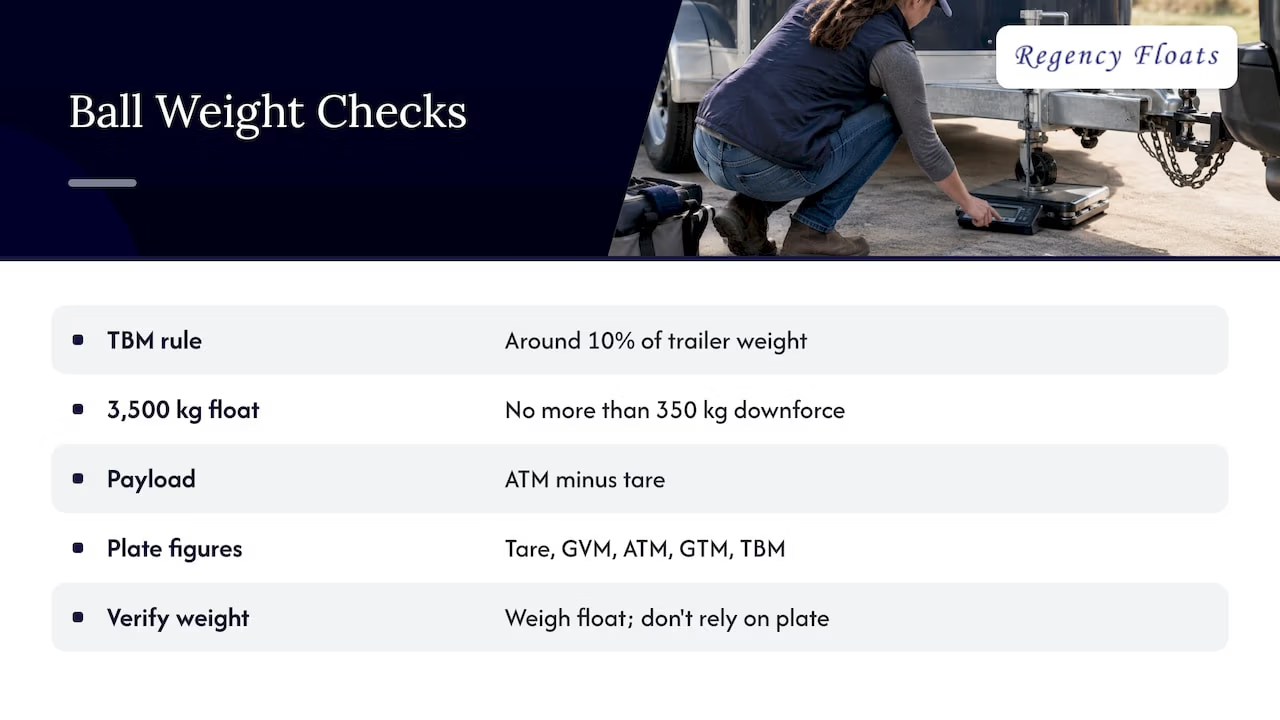
Once the float is level, check what it puts on the ball. A horse float’s compliance plate holds the key figures: tare, GVM, ATM, GTM and tow ball mass. The Victorian weighing business adds that you should weigh the float rather than rely on the plate alone, then work out payload by subtracting tare from ATM.
A rule of thumb from an Australian horse media piece is that TBM should be around ten percent of the trailer’s weight. For a 3,500 kg float that means no more than 350 kg of downforce. The same article recommends taking the loaded car and float across a weighbridge. That fits the WA guide’s 8 to 10% of ATM, within the tow bar’s limit.
If you are still working out what your own combination can handle, our guides to horse float weight and how to calculate what your vehicle can legally tow walk through the numbers step by step.
Final checks before you load a horse
Height set, ball weight in range. Before the horse goes on, run through these. They draw on the WA guide, the HRIA sheet and Pony Club Australia’s guidance.
- Tyre pressures correct on both vehicle and float, as the WA guide recommends.
- Tow ball correctly tensioned and the right size, with the coupling locked in place.
- Lights working. The HRIA sheet requires brake and indicator lights in working order and connected.
- Safety chains attached to the tow vehicle and off the ground, per the same sheet.
- Breakaway system working, and the tow bar rated for the float and load. Pony Club Australia lists these checks for every trip.
- Cargo secured in the float and the vehicle.
Pony Club Australia also points out that observing towing limits is both a legal and a welfare responsibility, because exceeding them can compromise braking, steering and stability. We keep a printable routine in our horse float pre-trip checklist, and the safe loading and towing practices section of our towing guide covers loading order.
Starting with a float built to sit level
If you are buying a float and want it to couple level to your vehicle, tell us your tow vehicle, the ball height you measured loaded, and the horses you carry. Regency Floats has been building horse floats for over 40 years, and our range includes standard, deluxe, camper, gooseneck, straight load, thoroughbred and 2 horse models. Floors are backed by a ten-year warranty, and floats can be customised to suit how you travel.

See the full Regency Floats range or go straight to our 2 horse float range to compare models against your vehicle’s measurements.
A simple setup routine to repeat
Once you have done it properly the first time, the routine takes about 20 minutes:
- Load the vehicle as you normally travel.
- Measure to the centre of the ball and confirm it is inside 350 to 460 mm.
- Couple the float and check it sits level by eye and with a spirit level.
- Adjust only to positions your tow bar’s plaque allows.
- Weigh the loaded combination and check ball weight against 8 to 10% of ATM and the tow bar limit.
- Run the final checks and keep your numbers on record.
Repeat after any change: a new vehicle, new suspension, a different tow bar, a heavier load, or a new float. Your tow vehicle’s capability is the base for everything else.
FAQ
What is the correct tow ball height for a horse float?
For a 50 mm ball, the centre should sit between 350 mm and 460 mm from the ground with the vehicle loaded, according to the WA Safe Towing Guide. Within that window, the right height is the one at which your float sits level when coupled.
Should I measure tow ball height with the float attached?
Measure the loaded vehicle on its own first to confirm it is inside the window. Then couple the float and check how it sits, since the vehicle drops when ball weight lands on it. Both readings tell you something different.
Can I adjust my tow ball height myself?
Only to positions the tow bar is designed for. Some tow bars allow the tongue to be inverted and carry a plaque showing the alternative position and its load rating. For anything else, such as a step-up or adjustable tongue, use a rated product fitted by a tow bar specialist.
How much weight should be on the tow ball?
The WA guide gives 8 to 10% of the ATM, up to the tow bar load limit. The best way to confirm it is to weigh the loaded combination at a weighbridge.
Why does my float sit nose-down when I hitch up?
Common causes are a ball that sits too low for the float, too much ball weight, or a tow vehicle that sags at the rear. Check the loaded ball height and weigh the combination before changing parts.